When people talk about Tuscan hilltop towns, the most popular are places like Siena, Montepulciano or San Gimignano. For us though, if we want to experience the real Tuscany, our top choice is the city of Arezzo. Located inland, close to the border with Umbria, Arezzo has a special character that is reflected in the architecture, the food and the people. Get off the beaten path with us and find out why you should add Arezzo to your Italy trip plans.

All About Arezzo
Like many of the cities and towns in this central part of Italy, Arezzo’s origins date back to Etruscan times. The Etruscan people established their presence here well before the ancient Romans came along, but were conquered by Rome and Arezzo became one of many places controlled by the rising power.
Arezzo was on the route of the ancient road that connected Rome to Florence and further north to the coast of the Mediterranean Sea, the Via Cassia. Even after Rome fell, this road connection meant that Arezzo was still an important place. It became a major bishopric, with beautiful churches and abbeys built in the city and the surrounding countryside. Medieval Arezzo was rich and powerful, home to one of the early universities and became a cultural center. Poets, artists, sculptors, scientists and more all contributed to the city.
This success was not to last unfortunately. After a long period of independence, Arezzo fell under the control of Florence in the 14th century. Under Florentine rule the city slowly became less prestigious. Initially the Medici rulers took an interest in Arezzo, with a major redesign of the town center and new buildings added. However, from the 16th century onwards, Arezzo saw a slow decline in importance.
Modern Arezzo
However, after being bombed heavily in World War II, Arezzo saw a resurgence. The city was rebuilt and with renewed investment and interest, it is once again an important place to be. Multiple movies have been shot here, there is a large antiques market held here every month and a modern city has developed around the original hilltop town.
Even with everything Arezzo has to offer, it has stayed off the main Tuscan itineraries. This means you can explore without dealing with large crowds, even during peak season. It really is somewhere you can get to know the authentic Tuscany, which is part of why we love Arezzo so much.
Famous People from Arezzo
For a relatively small city, Arezzo is known for producing some truly remarkable people.
Examples include Guido d’Arezzo, a monk from the 10th century who lived in Arezzo most of his life and developed the music notation form that is still used today. Benefiting from the academic environment, Andrea Cesalpino, born in Arezzo in 1524, was a doctor and botanist whose studies on plants created the methods for scientifically categorizing different species and variants.
Piero della Francesca was someone who came to Arezzo later in life, but he left an enduring testament to the city. A painter, della Francesca learnt from masters like Donatello, Fra Angelico and Brunelleschi (who designed the iconic red brick dome of Florence’s cathedral). He was commissioned to create a series of frescoes in the Basilica di San Francesco, and the final result is considered one of the finest examples of Renaissance art anywhere.
Petrarch and Vasari
The two most famous Arezzo residents however are Giorgio Vasari and Petrarch. Both men were born in Arezzo, but went on to have a significant impact on the cultural landscape of Italy and Europe.
Petrarch was a poet and historian. Born in 1304, he worked on a large number of different things during his lifetime. He wrote poems in Italian (then still not commonly used as a written language) as well as Latin, wrote biographies of historical figures and more. Today you can visit the house where he was born and learn more about Petrarch’s life and influence.

Vasari was born in Arezzo in 1511, and soon headed to Florence, which was the place to be for artists at the time. Vasari became a patron of the Medici family and while he was skilled as a painter, his work as an architect has had a longer legacy. He created the Vasari corridor, renovated many of Florence’s major churches and also built a beautiful house in Arezzo which you can still see now.
How to Visit Arezzo
Thanks to Arezzo’s position between Florence and Rome, it is easy to reach the city. The regional trains that run back and forth between the two stop regularly in Arezzo, so you will have plenty of options for journeying to Arezzo by rail. The Arezzo train station is on the edge of the historic center too, so it is only a short walk up to Piazza Grande or the cathedral.
When booking your train tickets, it’s worth checking the total journey time not just the departure time. There are various services that stop at Arezzo, but some are quicker than others. So, if you’re planning a day trip, our recommendation is to choose one of the faster trains so that you can maximize your time in Arezzo.
You can also drive to Arezzo, either in a rental car or with a private driver. It is close to the A1 autostrada and well connected to the surrounding Tuscan and Umbrian regions, plus there are plenty of car parks to choose from. Remember that without a specific permit you will not be able to drive right into the heart of Arezzo so look out for ZTL signs – the main parking lots are outside this restricted area luckily.
If you’re planning to stay in Arezzo for a few nights and use it as a base to explore the surrounding area, the closest airport for the city is Florence. This is a smaller airport however, so other options include the airports in Pisa, Rome and Bologna which have more flight routes to choose from.
What to See and Do in Arezzo
For a relatively small town center, there is plenty to occupy your time in Arezzo. If you’re planning to visit for a day trip, the different sights we talk about here are all close together so you can see a lot in one day. However, to really appreciate everything Arezzo has to offer, we recommend staying at least one night.
Here are the places we love visiting and the activities we recommend doing while you’re in Arezzo:
Piazza Grande
We could not start without talking about Piazza Grande, which has an unusual design and a sloping pavement. This really is the heart of Arezzo, and has been since the 13th century when the piazza was first built. Over the centuries the shape of the piazza has been amended and all sorts of buildings added around it, which makes it the ideal place to get a real sense of the development of Arezzo.
When you’re in Piazza Grande you can see the Palazzo delle Logge, with the elegant loggia designed by Giorgio Vasari. There are plenty of bars and restaurants in the loggia so take a seat and admire your surroundings. Looking out from the loggia, you can see the back of the Church of Santa Maria della Pieve to the right, with ornate columns and a bell tower.

The other buildings surrounding the piazza are historic palaces and towers which are all interesting, but our favorite is the Palazzo della Fraternita dei Laici, which has an ornate facade that includes one of the oldest astronomical clocks in Europe. Amazingly, this clock still works, and is connected to the three bells above.
Churches
Once you’ve soaked in the atmosphere of Piazza Grande, it’s time to get to know Arezzo better, and one interesting way to do this is to visit some of the city’s churches.
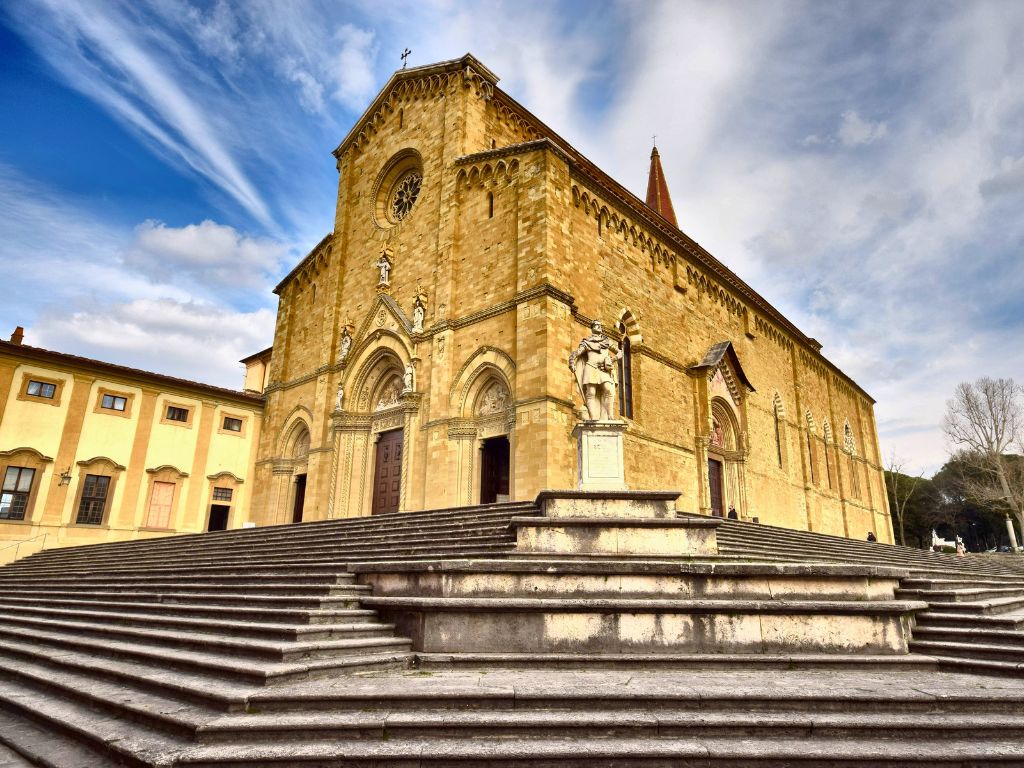
There are multiple churches in the historic center you can visit. Arezzo cathedral is outwardly quite plain, but step inside and you’ll be wowed by the soaring Gothic arches, vibrant stained glass windows and beautiful frescoes on the ceiling. Many contributions were added to the cathedral interior over the centuries, including architectural work by Vasari, a stunning depiction of Saint Mary Magdalene by Piero della Francesca and the hexagonal baptismal font which Donatello worked on.
To see more of Piero della Francesca’s work, visit the Basilica di San Francesco. This is another church whose simple facade does not give any indication as to the treasure inside, and we love spending time here. The church is full of wonderful artwork, but the cycle of paintings in the Bacci Chapel known as the Legend of the True Cross is a must-see for art lovers. Depicting various instalments in the story of the cross that Jesus Christ was crucified on, the combined effect of Piero della Francesca’s work is breathtaking.
Another one of Arezzo’s fascinating churches is Santa Maria della Pieve, which sits between Piazza Grande and the main street of Corso Italia. One of the oldest churches in the city, its origins date back to the 6th century (although the majority of the current building dates to the 13th century). This church feels more plain inside, but you can really get a sense of Arezzo’s history here.
Museums
Outside of Arezzo’s churches, there are a few museums that are worth visiting here.
The main one that we love seeing is Casa Vasari, which was the family home of Giorgio Vasari. He worked on the decor in the home for around 20 years after purchasing it in 1541. It remained a private residence until the Italian state purchased the house in 1911, which turned it into a museum. The different rooms have been restored and the effect is breathtaking – you can really get a sense of Vasari as a person as you walk through each one. There is also a gallery with paintings by his contemporary artists upstairs.
To learn about Arezzo’s much older history, you need to visit the Archaeological Museum and Roman amphitheater (which are at the same location). In this museum there is an interesting collection covering the history of Arezzo. Prehistoric finds, Etruscan items from local sites, ancient Roman pieces and more are displayed over two floors. The structure of the building is curved as it sits on the foundations of the ancient amphitheater, and outside in the garden you can see the ruins of what is left.
Finally, if you want to see more from the Middle Ages, you can also spend some time in the Museum of Medieval and Modern Art. This is focused on art from the 13th century through to the 19th century, so you can trace the progression of painting styles.
Outdoor Areas
If you’d prefer to spend more time outdoors, you can still see a lot in Arezzo. As well as Piazza Grande, one of our favorite places to go in Arezzo is the Parco il Prato. This park is at the back of Arezzo cathedral and stretches out across the top of the hill to the Medici fortress. It is not just a large green space where you can relax, this is the original heart of the city. Wander the paths, take in the views of the cathedral and visit the Medici fortress – the views from up here are spectacular.
Simply wandering around the historic center will reward you, and we often set off without a clear plan of where we’re going. Some particular sights to look out for as you explore are:
- Palazzo dei Priori – this castle-looking palace and tall tower were built in the 14th century to house the administrators of the city, and is still Arezzo’s town hall today.
- Monument to Ferdinando I de’Medici – close to the Palazzo dei Priori, in front of the cathedral, is this tall white statue to the Medici Grand Duke, erected in 1594 to commemorate the revitalization of Arezzo by the Florentine rulers.
- Palazzo Pretorio – on the outside of the medieval palace you will see that the facade is covered in coats of arms. These date from the 15th century, when it was necessary for anyone who governed Arezzo in some way to leave a permanent mark of their family name.

Special Events in Arezzo
One of the things that makes Arezzo stand out for us, is the fact that the city is home to lots of fun and interesting events.
Arezzo Antiques Market
One of these takes place every month, the Arezzo Antiques market which is held on the first Sunday of each month and the previous Saturday. The Arezzo antiques fair is said to be the largest and oldest in Italy, and it is a big deal. People come from all over to browse the stalls and barter for good prices, but if you’re like us, just witnessing the event and doing some window shopping is a lot of fun.
Taking over Piazza Grande as well as many of the surrounding streets, there is always a huge selection of items for sale. Everything from jewelry and ancient coins to vintage furniture and books is on offer, so even if you don’t have much space in your luggage, you can still bring home something unique. For details of upcoming events, check out the official website here.
The Saracen Joust
The other stand-out event for us is the Giostra del Saracino, or Saracen Joust. The origins of the jousting tournament are medieval, but the current event was started in 1931 as a historical revival of a tradition that had fallen out of use. Dressed in medieval costume and upholding the rules from the Renaissance period, knights of the Four Quarters of Arezzo compete on horseback in a series of jousts.
Arezzo hosts this event twice a year, in June and September. The June event is held at night and the September one during the day, but both come with performances and music from a whole cast of people dressed in costumes from the Middle Ages. This is something unique to Arezzo and the local people are very passionate about the outcome – what started as a historical revival has become a very real competition!

See Another Side of Tuscany
Are you ready to discover Arezzo? This beautiful, fascinating city offers visitors a different idea of what Tuscany is all about, which is why it is a crucial part of our Italy Harvest experience. Find out more about what this adventure includes here, and if you’d like to join us this year, get in touch today.